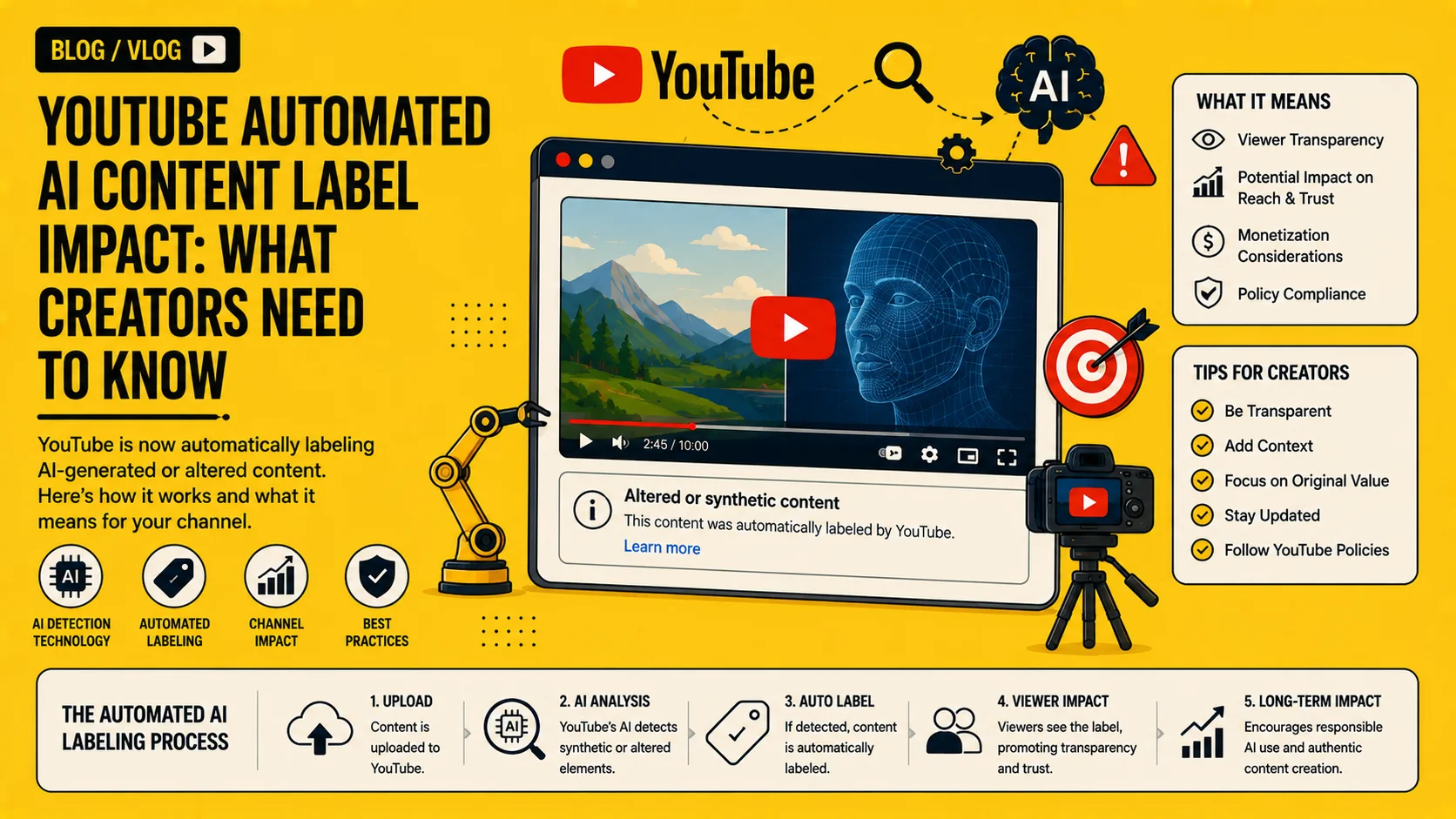
Transparency at the Foreground: YouTube's War on Undisclosed AI Slop
As generative artificial intelligence moves from low-fidelity experiments to photorealistic masterpieces, video platforms are facing an existential challenge: preserving viewer trust. In response, **YouTube** has initiated a dramatic policy escalation by introducing an **automated detection layer** that identifies and labels undisclosed photorealistic AI content.
In partnership with the **C2PA (Coalition for Content Provenance and Authenticity)** standards body, YouTube is shifting AI disclosures from hidden menus to front-and-center player overlays. Creators who rely on generative video tools, synthetic avatars, or digital voice synthesis must now adapt to a highly visible transparency environment.
This deep-dive analysis unpacks the mechanics behind YouTube's auto-detection, the new UI/UX placements, and the direct (and indirect) impacts of these labels on video recommendation algorithms and ad revenue.
📍 The New UI/UX Placement Paradigm
Disclosures are no longer buried inside the description tab. They are now integrated directly into the viewing container:
- Long-Form Videos: The "AI" indicator is displayed directly beneath the video player, next to the title, demanding immediate viewer attention.
- Shorts Player: The label is rendered as a persistent semi-transparent overlay directly on top of the Shorts feed, ensuring mobile users see it instantly.
Automated Detection vs. Manual Self-Disclosure
While YouTube has required creators to self-disclose "altered or synthetic" photorealistic content since early 2024, the platform is now taking matters into its own hands. Rather than solely relying on the honor system, YouTube’s backend systems are actively scanning uploaded footage for digital signatures and visual patterns indicative of generative AI.
According to YouTube Creator Liaison **Rene Ritchie**, if the automated systems flag a video as having significant photorealistic AI, and the creator failed to disclose it during the upload process, the system will **apply the label automatically**.
It is critical to note that the automated scan does *not* excuse creators from their manual disclosure obligations. Knowingly failing to declare synthetic content can still lead to strikes, monetization suspension, or account termination under YouTube’s community guidelines.
Unmasking the Permanent Labels & C2PA Metadata Standards
For certain classes of content, the AI label is now absolute and unremovable. When content is created using YouTube’s native AI creative suite (such as **Veo** or **Dream Screen**), the platform embeds a permanent watermarking layer that locks the disclosure into the file.
Additionally, YouTube fully supports the **C2PA open standard**. If an uploaded video carries C2PA metadata showing that the file was generated entirely through AI image or video models (like OpenAI's Sora or Midjourney), YouTube's ingestion pipeline reads the metadata header and permanently locks the "AI" label onto the video container.
However, if you feel your human-created content was incorrectly flagged by the automated auto-detection system, you are not entirely powerless. YouTube has introduced a **formal dispute workflow within YouTube Studio**, letting creators challenge automated labels and submit them for secondary human review.
YouTube AI Content Labeling Rules
| Content Category | Label Status | Can Be Disputed? | Examples / Triggering Factors |
|---|---|---|---|
| Photorealistic AI | Mandatory (Auto-Detected) | Yes | AI face-swaps, deepfakes of real people, simulated natural disasters |
| Stylized / Animated AI | Not Required | N/A | Fantasy landscape drawings, cartoon filters, clearly synthetic animations |
| YouTube Native AI | Locked / Permanent | No | Videos generated via Veo, backgrounds created via Dream Screen |
| Standard Video Polish | Exempt | N/A | AI-assisted color grading, automatic audio noise reduction, background blur |
Will the AI Label Destroy Your Views and Ad Revenue?
The number-one concern among creators is algorithmic suppression. Will the presence of an AI label cause YouTube to downrank your videos in recommendations or limit ad eligibility?
Rene Ritchie was direct on this point: **"These labels alone do not affect how our videos are recommended or whether they can earn money."** The algorithm does not penalize a video file simply because the "AI" metadata tag or player overlay is present.
However, this does not mean your channel's performance will remain completely unchanged. The threat is not the algorithm—it is the **audience's psychological reaction**.
When a viewer is presented with a prominent, unskippable label declaring a video is synthetic, their behavior changes:
- Click-Through Rate (CTR) Slumps: Viewers browsing their feeds might see the visual label on the Short or next to the thumbnail and choose to skip the video entirely.
- Average View Duration (AVD) Drops: Skeptical viewers who click might bounce within the first 5 seconds upon seeing the overlay, signaling to the algorithm that the video is unengaging.
- Comment Sentiment Changes: Discussions may shift from the video's actual topic to debates about AI usage, lowering overall comment health signals.
In this indirect way, human behavior shapes the algorithm. If viewers react negatively to your synthetic content, the system will naturally downrank your videos due to declining engagement signals.
💡 Strategic Playbook for AI Creators
How should modern video producers and marketers adapt to the transparent YouTube ecosystem?
- Lead with Premium Storytelling: AI tools should enhance, not replace, compelling narratives. If your storytelling is exceptional, viewers will stay engaged regardless of the label.
- Pre-Empt the Disclosure: Don't let the label surprise your audience. Proactively mention or humorously reference your use of AI in the video's intro. Authentic transparency breeds trust.
- Understand the Boundaries: Standard touch-ups (noise filters, visual correction, templates) do not require disclosure. Keep your production clean and avoid photorealistic AI unless it adds severe value.
The Future of Authentic Content
YouTube's auto-labeling shift is a watershed moment for the creator economy. By making disclosures visible, YouTube is attempting to build a safe harbor for high-integrity, human-created journalism and entertainment, while organizing the inevitable surge of synthetic media.
Rather than viewing this as a limitation, successful creators should treat it as an opportunity. Channels that blend high-concept human imagination with transparent generative tools will survive and thrive in this new, fully labeled ecosystem.