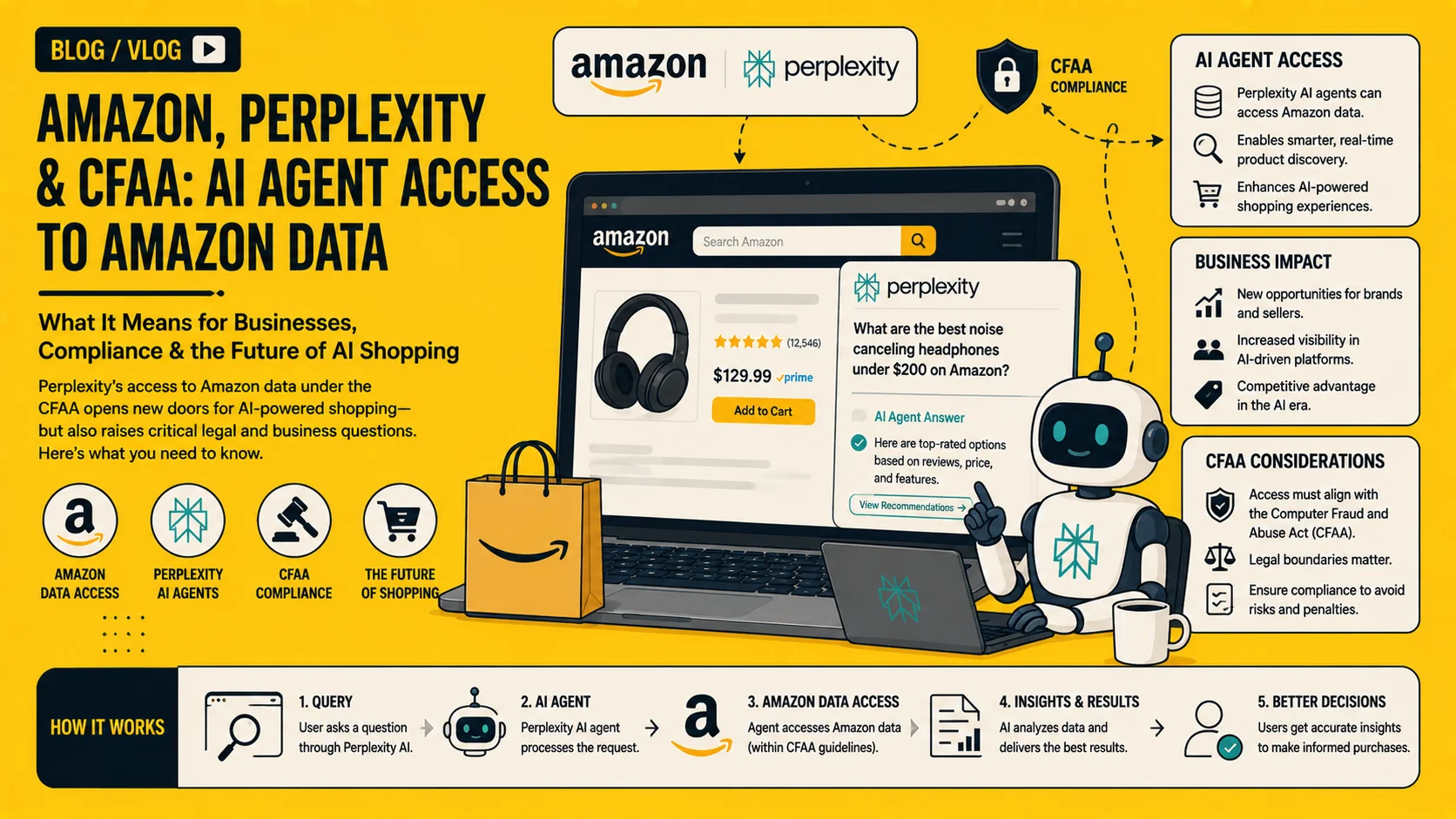
The Battle for Agentic Commerce: Who Controls Website Access?
In the rapidly accelerating era of **agentic AI**, we are moving away from users manually browsing web pages and towards autonomous **AI agents** acting on their behalf. But this evolution has triggered an existential legal collision. In the landmark case of **Amazon v. Perplexity**, a federal court is deciding a fundamental question: **Does a website's Terms of Service override a user's right to delegate tasks to an AI browser agent?**
The lawsuit, centered in the Ninth Circuit Court of Appeals, revolves around Perplexity’s AI-powered **Comet browser**. By using stored user credentials, Comet can log into Amazon, compare product pricing, and checkout on the user’s behalf. Amazon argues that this automated transaction represents a violation of the **Computer Fraud and Abuse Act (CFAA)**—the 1986 federal anti-hacking statute.
This analysis explores the core legal doctrines at play, the strategic timelines, the potential outcomes of the June 11 oral arguments in Seattle, and what this precedent means for sitemaps, crawlers, and website terms across the globe.
📅 Landmark Litigation Timeline (2026)
- March 10: U.S. District Judge Maxine Chesney grants a preliminary injunction blocking Comet from Amazon's logged-in areas, accepting Amazon's broad CFAA argument.
- March 18: The Ninth Circuit Court of Appeals pauses the injunction, allowing Comet to resume operating while the appeal is heard.
- May 8: Perplexity files its formal appellate brief, backed by amicus briefs from Mozilla, the Electronic Frontier Foundation (EFF), and digital-rights groups.
- June 11: Scheduled oral arguments in Seattle to decide the load-bearing precedent for agent-as-visitor access rights.
Understanding Amazon's CFAA Argument
Passed in 1986 to prevent federal database intrusions and hacking, the **Computer Fraud and Abuse Act (CFAA)** has been adapted in civil litigation to govern scrapers, automated scripts, and shared accounts.
Amazon’s legal theory relies on a strict interpretation of server authorization:
- Contractual Prohibition: Amazon's terms of service explicitly forbid automated scripts and software agents from accessing password-protected domains.
- Identity Separation: Amazon argues that when Comet makes requests, the *agent itself* is the visitor. Because Amazon's authorization only extends to natural-person users, the agent is acting "without authorization."
- Irrelevance of User Consent: Even if a customer gives Comet their credentials and explicit instruction, Amazon maintains that this does not grant Perplexity legal authorization to traverse its servers.
The District Court accepted this reasoning, establishing that terms of service restrict *who* can enter logged-in portions of a domain.
Perplexity's Defense: The Agency Doctrine & Van Buren
Perplexity, represented by leading digital rights litigators, argues that Amazon's theory represents a dangerous overreach that criminalizes standard software helpers. Their counter-defense rests on two major legal columns:
First, they point to **legal agency doctrine**. For centuries, common law has recognized that when a principal authorizes an agent to act, the agent’s actions are legally attributed to the principal. If a user instructs an AI agent to purchase coffee on their behalf, the AI is merely a technological extension of the user's authorized access.
Second, Perplexity leverages the Supreme Court's landmark ruling in **Van Buren v. United States (2021)**. In that case, the Supreme Court narrowed the CFAA's scope, declaring that individuals who have permission to access a system cannot be prosecuted under federal hacking laws simply for violating contractual terms of service. Perplexity maintains that using a user-delegated agent is a contractual issue, not a federal hacking crime.
Website Owner Strategic Options Matrix
| Access Posture | Operational Mechanics | Pros / Opportunities | Cons / Systemic Risks |
|---|---|---|---|
| Welcome Posture | Explicitly permit AI agents inside terms; optimize sitemaps for agent parsing. | Attracts hyper-efficient AI shopping and booking traffic. | Increases server queries; requires granular traffic shaping. |
| Block Posture | Ban agents in robots.txt; utilize Web Application Firewalls (WAF) and CAPTCHAs. | Protects proprietary pricing data and logged-in layouts. | Risk of alienating customers who delegate online tasks to software. |
| Partner Posture | Build machine-first API surfaces for agents to transact directly. | Eliminates scraping completely; secures structured orders. | Requires technical investment to launch specialized merchant APIs. |
Why the Precedent Matters Beyond Amazon
The Ninth Circuit's ruling will immediately reshape the entire tech sector:
- If Amazon Wins: Every online platform gets a legal veto over user-authorized software. Retailers can legal-block price-comparison engines, flight consolidators can ban booking agents, and banks can sue third-party financial aggregators under criminal hacking laws.
- If Perplexity Wins: The CFAA is pushed back into its narrow hacking lane. Platforms lose the threat of federal litigation and must handle agent access at the technical layer—through APIs, WAF rules, and robots.txt directives.
🛠️ Action Plan for Website Owners
Do not let the court decide your digital sovereignty. Take immediate strategic control of your website:
- Audit Your Terms of Service: Update your contractual access clauses. Clearly separate rules for scraping bots from rules for user-delegated agents who are actively transacting on personal accounts.
- Verify Your robots.txt Posture: Actively monitor agent requests. Keep distinct lists for search-indexing crawlers (GPTBot, ClaudeBot) and browser-delegated transactions (Perplexity Comet).
- Explore Machine-First Interfaces: Prepare for agentic commerce. Building structured APIs for machine parsing will protect your backend servers while securing high-value transactions.
The Dawn of Agentic Sovereignty
The Amazon v. Perplexity appeal is a constitutional moment for the internet. By determining whether artificial intelligence agents can act as legitimate legal proxies for human users, the Ninth Circuit is drawing the boundary lines of digital sovereignty.
Instead of waiting for the judicial gavel, website administrators and digital agencies should establish clear, machine-readable interfaces and proactive agent postures today to thrive in a fully automated web ecosystem.