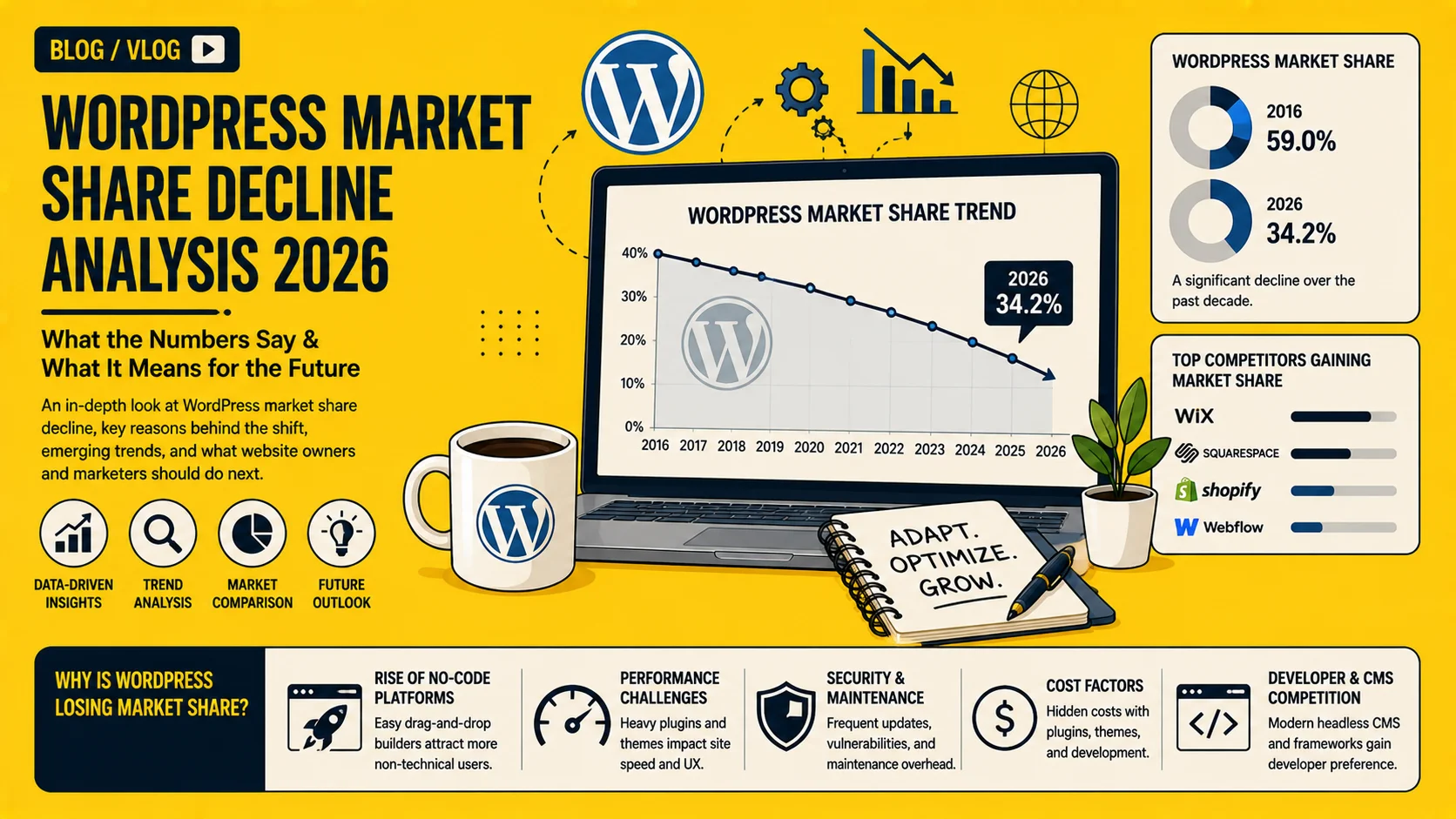
The Deceleration of a Giant: Tracking the Shifts in Modern CMS Dominance
For nearly two decades, WordPress has reigned as the undisputed operating system of the World Wide Web. Powering over two-fifths of all websites, its dominance was widely assumed to be permanent. However, new telemetry data from web technology census firm **W3Techs** and **HTTPArchive** reveals a historic and accelerating downturn.
Over the last year, WordPress has suffered a sustained, consecutive decline in global CMS market share. Far from a minor statistical anomaly, the **rate of this decline has doubled** in the first half of 2026. Developers, publishers, and enterprise brands are actively migrating to cleaner frameworks, closed-ecosystem alternatives, or modern static site architectures.
In this strategic breakdown, we analyze the quantitative data driving this shift, outline the underlying usability and performance factors, and address the leadership conflicts that have accelerated this unexpected platform migration.
📉 The Acceleration at a Glance
From 2025 through May 2026, WordPress's decline transitioned from a slow plateau to a sharp downward trajectory:
Deconstructing the Numbers: A Accelerated Six-Month Slide
According to the historical database compiled by W3Techs, the initial plateau in WordPress's adoption began as early as 2023. At that stage, industry experts like Katie Keith of *Barn2Plugins* observed a noticeable cooldown in product sales and plugin downloads. But by late 2025, that minor plateau converted into an outright slide.
In December 2025, WordPress held a **43.20%** share of all crawled websites. By late May 2026, that figure collapsed to **41.90%**. This represents a loss of **1.30 percentage points in a mere six months**—which is double the entire decline registered throughout the 12 months prior.
In stark contrast, other leading web platforms have remained highly stable or registered solid organic growth. Rather than representing an industry-wide stagnation in web creation, this trend is a distinct, localized challenge for WordPress.
Competitor Landscapes: Wix, Shopify, Squarespace, and Astro
Where are these websites migrating? The gains are being captured by two main classes of systems: **fully managed SaaS platforms** (Shopify, Wix, and Squarespace) and **high-performance modern developer frameworks** (such as Astro).
On the managed side, **Wix** recorded a **+0.60** gain over the last 12 months, followed by **Shopify (+0.40)** and **Squarespace (+0.20)**. On the custom developer side, the **Astro** static-site framework is experiencing exponential, viral growth—growing from 4.59 million downloads in January to an eye-popping 9.24 million monthly downloads in April 2026.
A major driver for this migration is performance. For years, WordPress has struggled with Core Web Vitals (CWV) technology comparisons. According to real-user data tracked by the HTTPArchive, WordPress consistently ranks near the very bottom for CWV passes among major content management systems. SaaS competitors like Wix, which historically struggled with speed, have spent millions to optimize their global CDNs, routinely outperforming complex, plugin-heavy WordPress architectures on mobile devices.
CMS Marketplace Fluctuations (May 2025 – May 2026)
| Platform | Market Fluctuation (Percentage) | Trend Direction | Core Technical Advantage |
|---|---|---|---|
| WordPress | -1.60% | Accelerating Decline | Open-source extensibility, massive plug-in catalog |
| Wix | +0.60% | Steady Growth Pass | Top-tier Core Web Vitals, zero-maintenance hosting |
| Shopify | +0.40% | Steady Growth Pass | E-Commerce standard, secure checkout, global scale |
| Astro | +101% (Downloads) | Exponential Spike | Extreme speed, zero-JS by default, islands architecture |
| Joomla | -0.30% | Slight Attrition | Legacy portal sites, database flexibility |
The Governance Factor: The WP Engine Conflict and Ecosystem Anxiety
While performance issues and strong competitive pressures laid the groundwork, there is a clear, undeniable correlation between WordPress's market share slide and the **unprecedented ecosystem conflict** initiated by Automattic founder Matt Mullenweg in late 2024.
In October 2024, Mullenweg launched a highly public, aggressive campaign against **WP Engine (WPE)**, a major managed WordPress hosting provider. The series of events sent shockwaves through the community:
- Temporarily blocking WPE-hosted websites from accessing WordPress.org update repositories, leaving sites vulnerable.
- Requiring contributors logging into WordPress.org to sign an affidavit certifying they were "not affiliated with WP Engine in any way."
- Cloning the popular *Advanced Custom Fields (ACF)* plugin, replacing WPE's version on the repository with a cloned fork.
- Banning prominent WPE employees and long-time open-source core contributors from global WordCamps.
The W3Techs quarterly chart illustrates a stark, undeniable line in the sand. Prior to these actions, WordPress was registering steady, moderate quarterly gains (climbing from 43.1% in late 2023 to its historical peak of 43.6% in January 2025). The moment the ecosystem stability was threatened by governance volatility, a continuous, monthly contraction began, culminating in the current 41.90% slide.
Ecosystem stability is the lifeblood of open-source projects. When enterprise stakeholders and agency leads realized that access to core theme and plugin repositories could be disrupted by executive decree, they began actively diversifying their technology stacks.
🛠️ Adapting to the New Multi-CMS Era
Agencies and brands must actively adjust their digital stack strategy to mitigate platform-specific risks:
- Embrace Headless Architectures: Decouple your frontend from your backend. Using headless WordPress or Astro allows you to change backends instantly if repository access is threatened.
- Core Web Vitals Remediation: If maintaining monolithic WordPress, prioritize severe asset optimization (using plugins like WP Rocket or migrating to Astro) to avoid losing organic search rank to Wix or custom JS frameworks.
- Repository Diversification: Avoid absolute dependence on the main WordPress.org repository. Secure direct premium licenses and manage crucial updates via private composer/npm repositories.
Can WordPress Bounce Back?
The decline from 43.60% to 41.90% represents millions of lost active installations, but WordPress is far from dead. The platform is currently launching major core upgrades integrating native generative-AI utilities, clean Gutenberg block abstractions, and refined editing workflows.
The community surrounding WordPress remains the largest and most passionate open-source network on Earth. If leadership prioritizes restoring ecosystem trust, standardizing Core Web Vitals performance updates, and simplifying developer workflows, WordPress can stabilize its share and resume its historical growth trajectory.