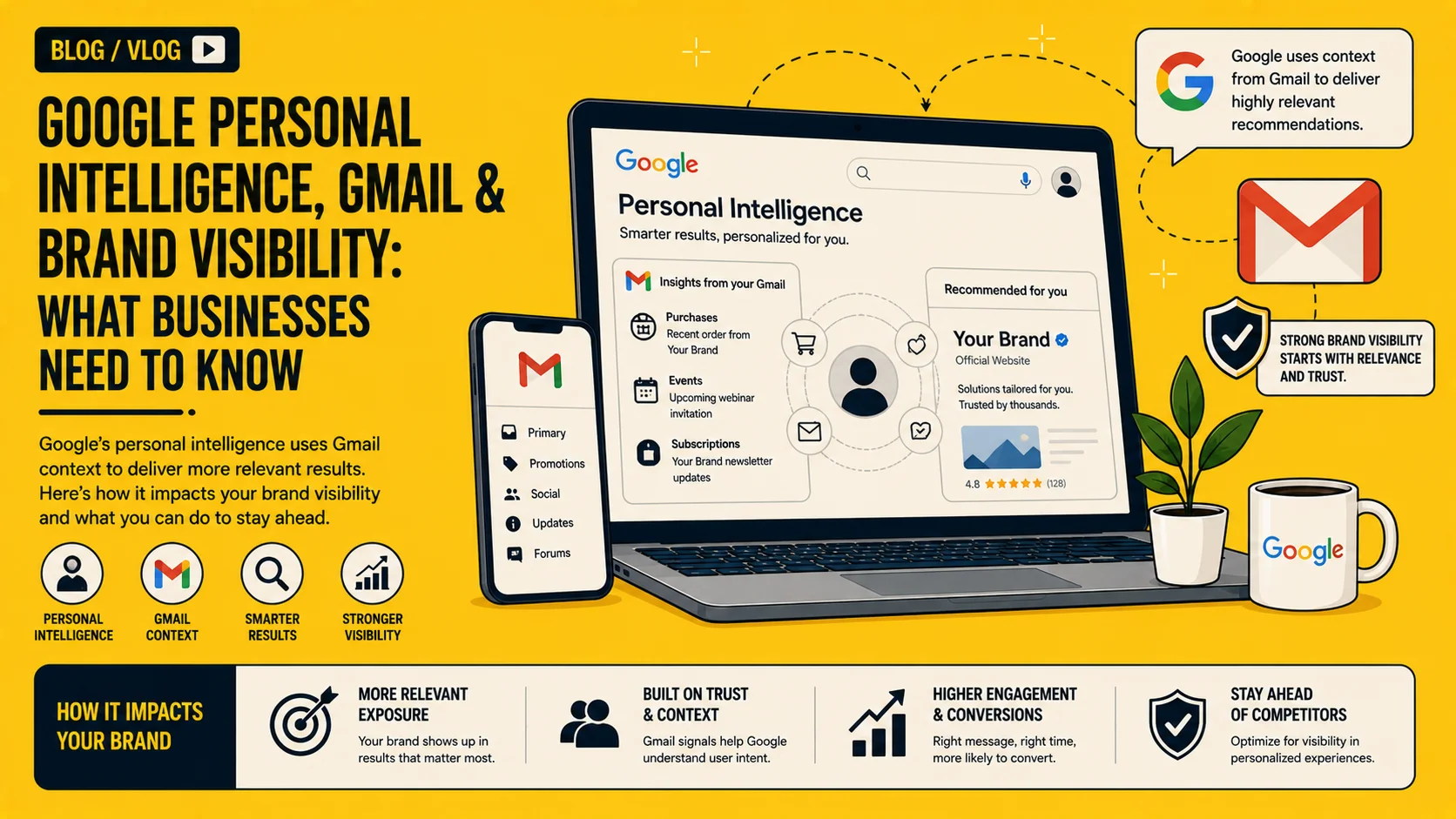
The Next SEO Frontier: Optimizing for the Personal Intelligence Layer
Search Engine Optimization has historically been a public game. We optimized for public crawlable web pages, public authority signals, and universal search queries. However, Google’s rollout of its **Personal Intelligence (AI Mode)** feature in the United States has introduced a massive private paradigm shift.
For the first time, Google is dynamically tailoring its generative search results by tapping into a user's private data sandbox—specifically **Gmail, Google Calendar, and Google Photos**. A groundbreaking new experiment by technical SEO agency **iPullRank** reveals that brands present within a user's Gmail inbox experience a monumental visibility boost inside Google's AI recommendations.
This strategic analysis deconstructs iPullRank's test parameters, outlines the exact percentages of visibility lift, compares Gmail vs. Google Photos signal strengths, and charts the future of **Generative Engine Optimization (GEO)** in a world of hyper-personalized search.
🚀 Key Brand Visibility Metrics
Seeding brands in opted-in Personal Intelligence accounts triggered a sweeping reorganization of search results:
Deconstructing the iPullRank Methodology
To measure these hidden effects, the research team at iPullRank—led by Director of Content **Garrett Sussman**—devised a rigorous 17-day testing matrix. They analyzed **1,922 AI Mode responses** across eight highly distinct product and service categories, including consumer products (coffee machines, running shoes, hoodies) and trust-heavy financial or technical services (banks, SEO agencies, streaming services).
The experiment utilized three distinct Google accounts to isolate variables:
- Account A (Blank Control): A fresh, empty Google account with no Personal Intelligence data integrations active.
- Account B (Seeded Experiment): A fresh account with opted-in Personal Intelligence, seeded with brand-related transactional emails in Gmail and photos in Google Photos.
- Account C (Real History): Sussman’s personal Google account, containing years of organic personal, professional, and consumer history.
By submitting six prompt variations across the eight product categories, the team compared the frequency and ranking of brand recommendations across all three environments.
Gmail vs. Google Photos: Gmail Rules the Recommendation Engine
The data yielded a clear victor in the race for internal ranking signals. **Gmail represents the absolute core of Google’s Personal Intelligence dataset**, exerting a massive influence over which brands are prioritized.
Brands seeded in a user’s inbox history appeared in a staggering **53.60% of all relevant responses** in AI Mode. On the other hand, brands that only had visual assets seeded inside Google Photos registered a meager **10.50% visibility rate**.
This implies that Google's semantic models are highly optimized for extracting text data, receipts, newsletters, order receipts, and shipping confirmations from email content. The visual modeling required to extract brands from photos is currently a far weaker ranking factor in the opted-in Personal Intelligence layer.
Personal Intelligence Impact Analysis by Category
| Seeded Source | Citations Rate | Optimization Difficulty | Strategic Value & Action Plan |
|---|---|---|---|
| Gmail (Emails / Receipts) | 53.60% | Medium | Extremely strong. Focus on email campaigns, receipts, and order confirmations. |
| Google Photos (Metadata / Exif) | 10.50% | High | Weak. Image recognition is currently secondary to textual database processing. |
| Consumer Product Prompts | 66.80% | Low | Highly responsive. Low barrier to entry for coffee machines, apparel, and shoes. |
| Regulated / Trust Categories | Low (Highly Guarded) | Extreme | Protected by search safety filters (YMYL). Hard to influence finance, medical, or agency recommendations. |
Web Grounding Stays Supreme: Personal Context Does Not Override Search
An essential finding for standard search marketers is that **Google's AI Mode does not abandon web grounding in favor of personal context**. The model does not live in an isolated bubble.
Even when personal context signals were strong, Google grounded **49% of all its citations** in external web links. This means standard web SEO remains highly critical—competitor websites, high-authority reviews, and Google Shopping listings were constantly cited alongside the user's personal brand references.
Uncited brand recommendations were extremely rare. The AI engine is designed to back up its personalized recommendations with real-time web documentation, confirming that standard SEO and public brand authority must act in lockstep with private email engagement.
🛠️ Email-SEO Integration Blueprint
How must SEOs and digital marketers adjust their strategy to claim territory in Google's Personal Intelligence layer?
- Maximize Inbox Real Estate: Treat transactional emails, order confirmations, and newsletters as critical SEO channels. Ensure your brand name, core product keywords, and links are clearly structured.
- Implement Rich Email Schema: Utilize structured data markup (such as Schema.org for emails) to let Google's extraction models parse receipts, reservations, and package shipments instantly.
- Maintain Unified Brand Naming: Ensure your brand is spelled and structured identically across your website, Google Shopping listings, social profiles, and email templates so the Personal Intelligence model can match private signals with public web grounding easily.
Entering the Era of Hybrid SEO
iPullRank's pioneering research confirms that the separation between email marketing and SEO is officially dead. The integration of opted-in Personal Intelligence into Google's search stack means your email inbox is now a direct ranking signal for personalized search queries.
By implementing rich schema schemas, securing inbox presence through transactional value, and maintaining high-authority public SEO grounding, smart brands will capture massive market share in this new, hyper-personalized AI landscape.