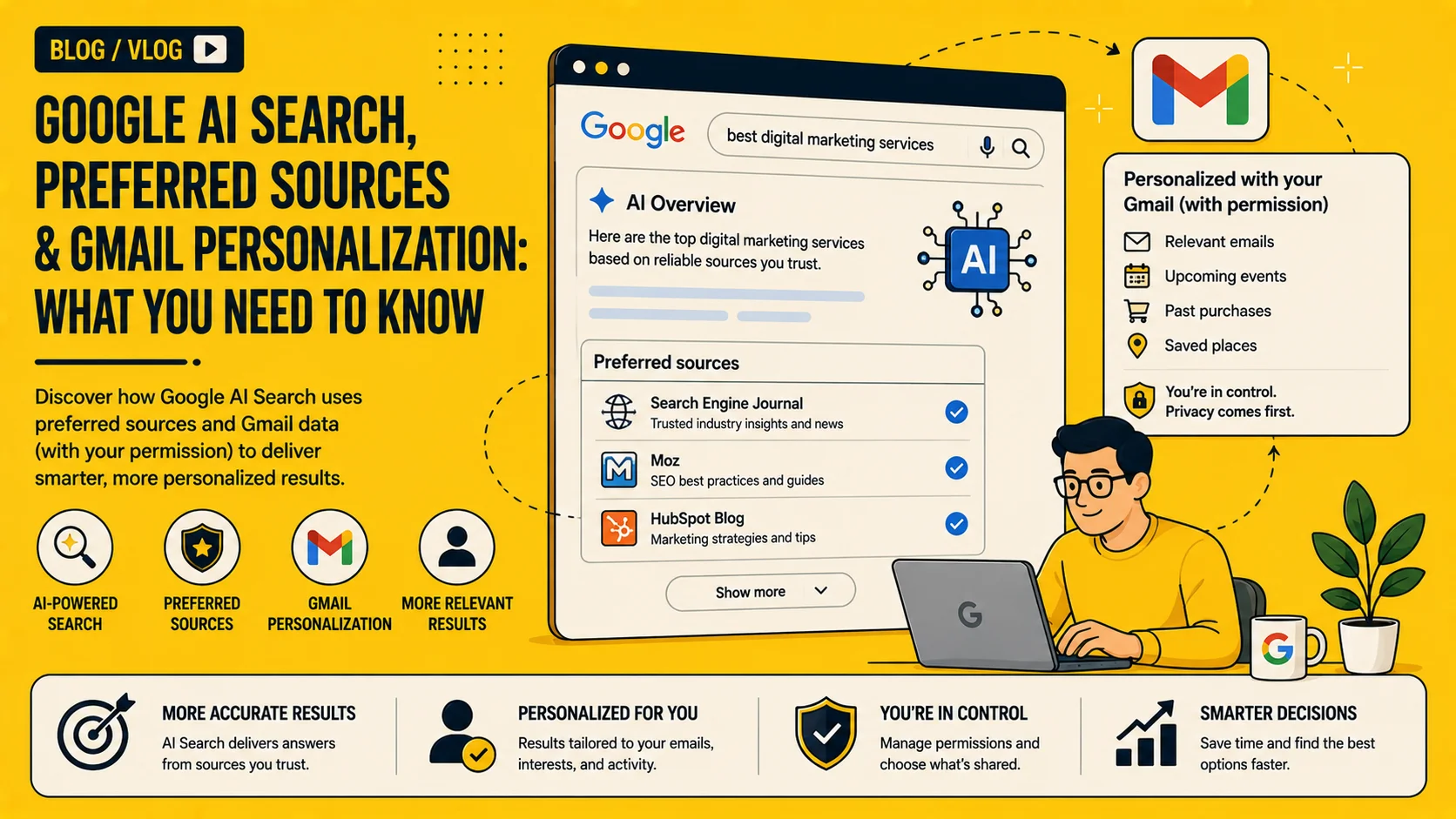
The Personalization Era: How User Data and Audience Loyalty Now Rule AI Search
For years, search engine optimization operated on a relatively straightforward premise: Google crawled the public web, indexed pages based on authority and relevance signals, and served a relatively consistent set of links to users searching for the same query.
That era is officially coming to a close. A series of major updates and research findings have confirmed that Google is actively pivoting toward **highly personalized generative answers**. By integrating **Preferred Sources** into AI Overviews, connecting user inbox data (Gmail) to **AI Mode recommendations**, and adjusting algorithmic opinion levels, Google is redefining how brand visibility is won and maintained.
In this deep-dive analysis, we deconstruct these shifts, draw insights from leading search experts, and outline the tactical changes your business must make to remain visible in AI-dominated search engines.
⚡ Weekly Search Intelligence Flash
- Preferred Sources Surge: Over 345,000 sources have been selected by readers so far, up from 90,000 at initial rollout.
- Personal Intelligence Lift: Brands that users actively interact with via Gmail receive a massive organic visibility boost in Google's AI Mode answers.
- Pichai's Admission: Google CEO admits AI Overviews are sometimes "more opinionated than they should be" as tuning continues.
Preferred Sources Explode Into AI Overviews and AI Mode
Google has officially expanded its **Preferred Sources** feature beyond the initial "Top Stories" feed. The personalization mechanism is now fully active inside **AI Overviews (AIO)** and conversational **AI Mode** search responses.
This feature allows search users to explicitly select websites they trust and want to see more of. When a designated preferred site appears in a user's generative overview or AI Mode answer, it carries a prominent, custom preferred source badge. To accelerate adoption, Google is now allowing publishers and brands to directly invite their readers to add them as a preferred source using custom on-site buttons.
The implications of this shift are massive. According to internal data disclosed by Google, users are **twice as likely to click through to a link** if it is highlighted as a Preferred Source. As generative answers push standard organic results further down the page, securing this badge on your loyal readers' devices is a critical defensive play.
Leading SEO consultant **Marie Haynes** highlights the action-oriented nature of this update: “Google just made it so that any website can invite their readers to add them as a preferred source, making it more likely for that site to be seen in AI Overviews.” Additionally, Senior AI Search Optimization Specialist at Semrush, **Geertrui Laleman**, notes: “AI visibility is no longer only about being mentioned or cited. It is also about becoming a source people recognize, trust, and actively want to see in their results.”
Gmail as an SEO Signal: The iPullRank Personal Intelligence Study
Perhaps the most surprising discovery of the week comes from a comprehensive research report published by **iPullRank**. The study investigated how Google's **Personal Intelligence** option—a privacy-consented feature that draws upon a searcher's personal Google Workspace data—affects search output recommendations in AI Mode.
The findings were clear: once Personal Intelligence is activated, Google’s AI engine leans heavily on the user’s **Gmail inbox history** to rank brands in recommendation queries. Brands that the user has received emails from, purchased items from, or actively engaged with via email are significantly more likely to be cited in AI Mode recommendations.
This represents a major bridge between lifecycle email marketing and AI search engine visibility. If your email marketing teams are maintaining a clean, highly engaged subscriber list, those active email touchpoints are now directly feeding Google’s Personal Intelligence graph, raising your organic recommendation rate when subscribers search for product categories in AI Mode.
The Personalized AI Search Matrix
| Update Surface | Primary Driver | Optimization Focus | Visibility Value |
|---|---|---|---|
| Preferred Sources | User Consent / On-site buttons | Audience Loyalty & CTAs | 2x Click-Through Rate Multiplier |
| Personal Intelligence | Workspace Data / Gmail History | Active Email Engagement & CRM | AI Mode Recommendation Dominance |
| AIO Factuality Control | Algorithmic Tuning / E-E-A-T | High-Authority Citations & Data | Top-of-Page AI Summary Citations |
Sundar Pichai Admits AI Overviews are "More Opinionated Than They Should Be"
As Google shifts toward these deeply personalized formats, the core algorithms generating AI Overviews are undergoing intensive public scrutiny. In a detailed interview on The Verge’s *Decoder* podcast, Google CEO **Sundar Pichai** addressed the quality and reliability concerns head-on.
Pichai acknowledged that in some test scenarios, Google's AI Overviews were found to be **“more opinionated than they should be.”** He explained that the company is actively tuning its generative models to strike a more objective, balanced tone.
For SEO professionals, this is a crucial signal. If Google is actively reducing AIO opinions, it will increasingly rely on dry, highly factual syntheses. To earn citations in these summaries, your content must prioritize rock-solid factual clarity, structured data tables, and expert E-E-A-T credentials over marketing fluff.
🚀 The Personalized AI Search Playbook
- Build a "Preferred Source" Campaign: Add clear, highly visible CTAs on your primary content hubs prompting loyal readers to add your domain to their Google Preferred Sources list.
- Align Email and Search Optimization: Coordinate with your lifecycle marketing teams. Maintain high email open rates, click-through rates, and active replies to feed positive signals into subscribers' Personal Intelligence graphs.
- Structure Facts for Objective Crawlers: In light of Pichai's objective tuning, structure your product data and research tables cleanly to serve as easy citation sources for an algorithm moving away from opinionated summaries.
The democratization of AI search visibility means that standard page rank is no longer the sole determinant of organic discovery. By building deep audience loyalty (Preferred Sources) and maintaining active touchpoints across channels like email, your brand can secure an unshakeable presence in the personalized search engines of tomorrow.